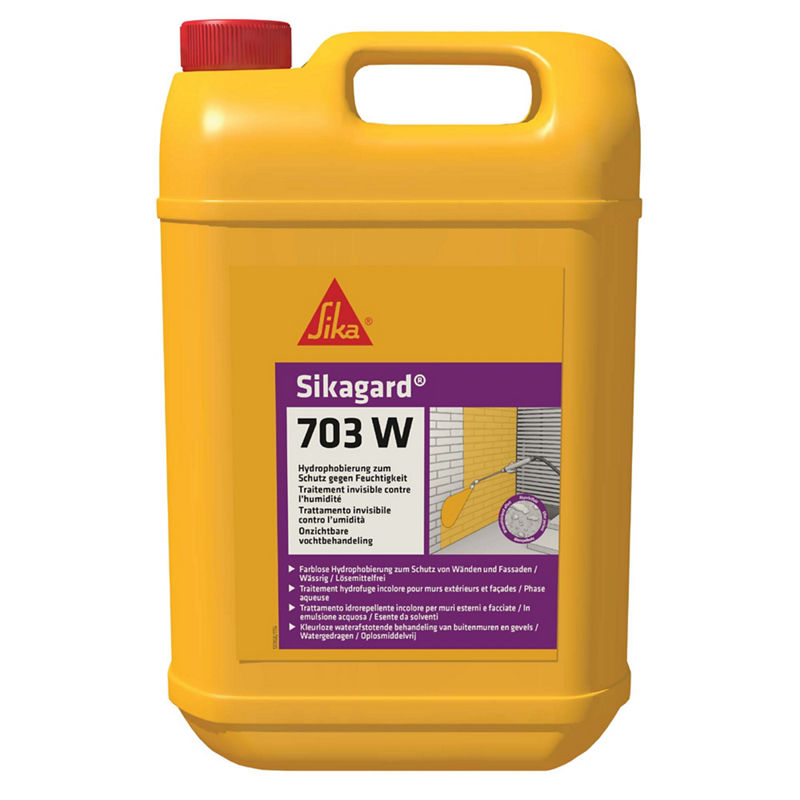
Sika Sikagard 703W
Sika Sikagard 703W
Documents
Sikagard®-703 W is a ready-to-use, silane/siloxane combination-based water repellent impregnation for building facades and mineral substrates. It penetrates the substrate to form a hydrophobic layer, effectively reducing water absorption while maintaining vapour permeability without altering appearance. Consumption approx. 150–500 g/m², application temperature +5°C to +35°C.
Product Overview
Sikagard®-703 W is an emulsion-type, ready-to-use silane/siloxane combination water repellent impregnation. The water-based, environmentally friendly formula penetrates into the substrate to form a lasting hydrophobic protective layer, effectively reducing capillary water absorption and preventing rainwater ingress. The treated surface typically shows no visible change in appearance and retains water vapour permeability (breathability) without forming a surface film.
Key Features
- Silane/siloxane combination formula for strong water repellency
- Penetrating protection — does not alter substrate appearance
- Maintains substrate breathability (vapour permeable)
- Reduces water absorption, improves resistance to staining, moss and lichen growth
- Water-based environmentally friendly formula, VOC content only 84 g/L
- Ready to use — no dilution required
- Can be overcoated with suitable paints after treatment
Applications
- Building facade water repellent treatment
- Mortar, masonry, natural stone surface protection
- Concrete facade and element waterproofing
- Asbestos cement board surface waterproofing
- Water repellent impregnation for various absorbent mineral substrates
Why Choose Sikagard 703W
Sikagard®-703 W combines silane and siloxane technology for dual advantages of deep penetration and surface protection. The water-based eco-friendly formula requires no dilution and is ready to use, ideal for large-area facade application. The treated surface retains its original appearance and breathability, protecting buildings from water damage without impeding natural moisture exchange — a professional choice for facade waterproofing.
Packaging
1 kg, 4 kg or 20 kg pail
Consumption Guide
| Substrate Type | Approximate Consumption |
|---|---|
| Mortar | Approx. 150–200 g/m² |
| Other porous materials (brick, stone, etc.) | Approx. 300–500 g/m² |
Actual consumption depends on substrate porosity. A small-area trial is recommended before application.
Technical Specifications
| Property | Value |
|---|---|
| Chemical Base | Silane / siloxane combination emulsion |
| Appearance | Whitish liquid |
| Density | Approx. 1.0 kg/L (at +20°C) |
| Application Temperature (ambient & substrate) | +5°C to +35°C |
| Overcoating Wait Time | At least 5 hours (with Sikagard® or SikaColor® products) |
| Shelf Life | 12 months (unopened, original sealed packaging, dry and cool storage) |
| VOC Content | 84 g/L |
Important Notes
- Cement-based substrates must be cured for at least 7 days before application
- Protect glass surfaces and aluminium frames before application to avoid staining
- Cannot be overcoated with limewash or cementitious coatings
- Cracks wider than 300 μm must be repaired before treatment
- Optimum water repellent performance is achieved after a few days
- Water repellency is significantly reduced if the substrate is cracked
- A small-area trial is recommended before full application
FAQ
Will Sikagard 703W change the surface appearance after application?
Sikagard®-703 W is a penetrating water repellent impregnation. After application, it typically does not change the colour or texture of the substrate surface and is virtually invisible to the naked eye.
Can surfaces be painted after Sikagard 703W treatment?
Yes. After treatment, surfaces can be overcoated with water-based or solvent-based polymer paints, but not with limewash or cementitious coatings. When overcoating with Sikagard® or SikaColor® products, wait at least 5 hours.
What is the consumption rate per square metre for Sikagard 703W?
Consumption depends on substrate porosity. Approximately 150–200 g/m² on mortar, and 300–500 g/m² on porous materials such as brick and stone. A small-area trial is recommended to determine actual consumption before full application.