
-
Ardex WPM 300 水性環氧防水膜 / 20L
Vendor:Ardex -
Fosroc Nitocote CM210
Vendor:Fosroc 富斯樂 -
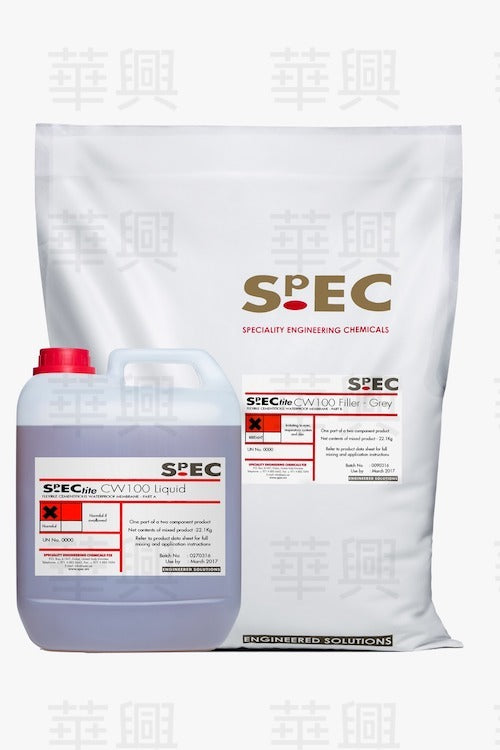
SPEC CW100
Vendor:SPEC -
Sika Sikagard 720 EpoCem
Vendor:Sika 西卡



Common scenarios in Hong Kong
1. Old buildings and "three-nil buildings"
Hong Kong has a large stock of aging walk-up buildings (唐樓) that commonly face the following obstacles to exterior waterproofing repair:
- Fragmented ownership, no management body — in buildings without an Incorporated Owners' Corporation, residents' organisation or property management company (commonly known as "three-nil buildings" / 三無大廈), it is impossible to obtain unanimous owner consent for exterior wall repairs
- Prohibitive scaffolding cost — exterior scaffolding on old buildings is expensive, and narrow rear lanes or unauthorised structures often make erection physically impossible
- Structural aging risk — older buildings may already suffer from concrete spalling or structural deterioration, making large-scale exterior works high-risk
In these situations, negative-side waterproofing applied from the interior is a remedial option that allows the property owner to actively manage water ingress.
2. Public housing and newly completed developments under warranty
In Hong Kong public housing and newly completed private developments, the building exterior is managed and maintained by the Housing Authority (房屋署) or the developer during the defects liability period (保養期). Interior renovation contractors and residents cannot carry out any waterproofing works on the exterior. When interior water ingress occurs but the exterior cannot be addressed due to jurisdictional restrictions, negative-side waterproofing from the interior serves as a temporary protective measure — controlling water damage to the interior finishes while awaiting official repair by the responsible authority.
⚠️ Before commencing work, confirm compliance with the building's Deed of Mutual Covenant and relevant regulations, and report the seepage case to the management office or responsible authority.
3. Slope retaining walls and basements
Hong Kong is built on hills, and a large number of residential and commercial buildings have basements, carparks or lower-level spaces backed directly against slopes or earth. The exterior face of the retaining wall is in direct contact with soil and groundwater, making excavation and exterior waterproofing physically impossible. When groundwater seeps through concrete cracks or pores into the interior, negative-side waterproofing is the only viable treatment. This is the most typical and straightforward technical application of negative-side waterproofing.
4. Modular Integrated Construction (MiC)
As Modular Integrated Construction (組裝合成建築法) becomes more common in Hong Kong — adopted in some public housing and transitional housing projects — its modular structure may present exterior-access constraints for future maintenance. When seepage occurs at module joints or the exterior envelope, traditional exterior repair methods can be significantly more difficult. Negative-side waterproofing may serve as one of the interior remedial options for such buildings, though the actual approach depends on the specific structure and cause of seepage — consultation with relevant professionals is recommended.
Selection guide
Negative-side waterproofing products fall into the following categories:
- Epoxy-modified cementitious mortars (e.g. Sikagard 720 EpoCem) — trowel-applied; epoxy resin penetrates concrete pores for chemical bonding while the cement component hydrates to form the waterproofing body; excellent adhesion to damp concrete
- Polymer-modified cementitious coatings (e.g. SPEC CW100, Fosroc CM210, Weber Elastic Slurry) — applied by brush, roller or trowel; good flexibility and crack-bridging ability
- Water-based epoxy membranes (e.g. Ardex WPM 300) — applied by brush or roller to form a thin waterproof film; solvent-free, safe for enclosed spaces, applies to damp and green concrete
Products differ in application method, suitable substrates and pressure resistance. The choice depends on site conditions and project design — refer to each product's Technical Data Sheet (TDS) or consult Wah Hing.
Related waterproofing methods
Negative-side waterproofing forms a continuous waterproof coating over the concrete surface. Where seepage is concentrated at individual cracks or joints, it can be combined with chemical injection (grouting) for localised crack sealing. The two methods address different types of seepage and can be used individually or in combination depending on site conditions.
Important note
Negative-side waterproofing is a remedial measure and not a replacement for proper positive-side exterior waterproofing. Water pressure may be diverted rather than fully eliminated, and the root cause — failed external waterproofing — remains. This method is only recommended where exterior access is genuinely impossible. If the structure shows severe cracking or settlement, a structural assessment by relevant professionals should be carried out first.
Most products typically in stock; individual items welcome to enquire.
Not Sure Which to Choose? These Guides Will Help

Interior Water Barrier: Negative-Side Waterproo...
How to choose negative-side waterproofing materials? A complete comparison of five products (trowel-applied, brush-applied, membrane-type), covering common Hong Kong scenarios including old buildings, public housing, retaining walls, MiC construction and...
Interior Water Barrier: Negative-Side Waterproo...
How to choose negative-side waterproofing materials? A complete comparison of five products (trowel-applied, brush-applied, membrane-type), covering common Hong Kong scenarios including old buildings, public housing, retaining walls, MiC construction and...


