
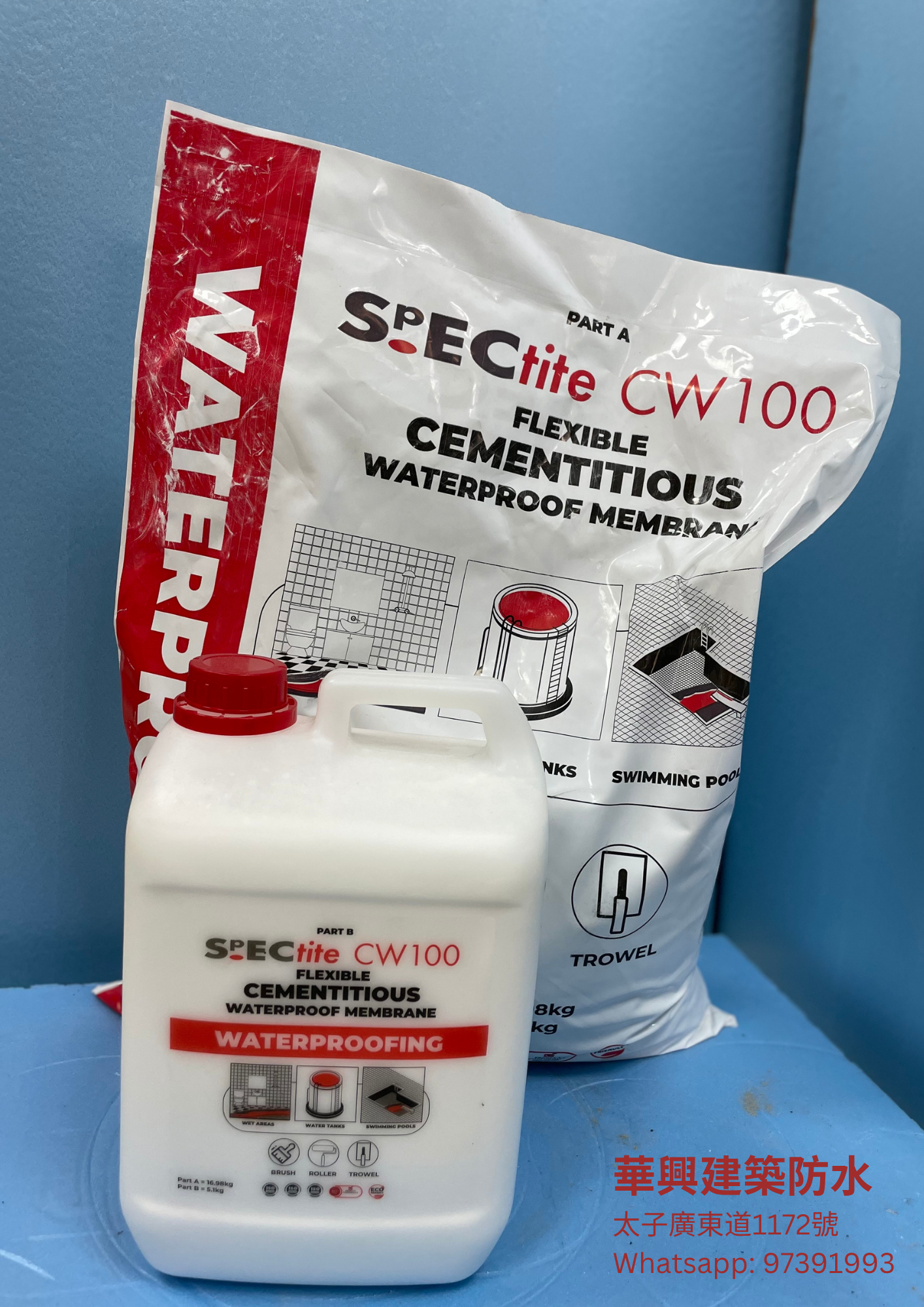
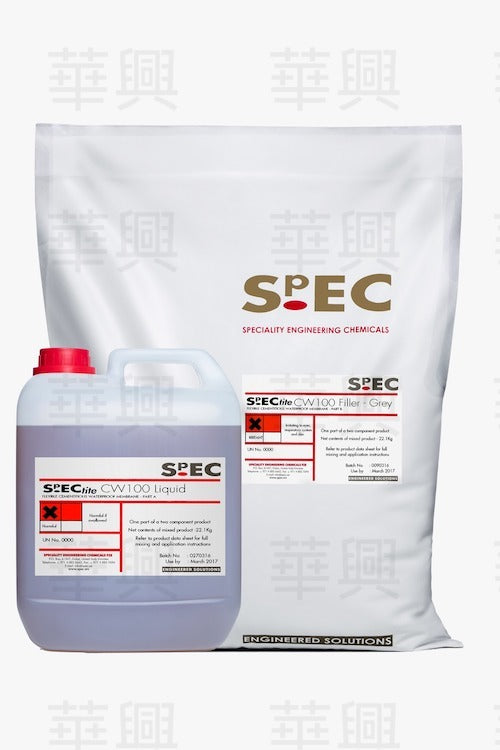
SPEC CW100
SPEC CW100
📋 Product specifications are for reference only.
All product details should refer to the official manufacturer documents. For official product data sheets or technical enquiries, please contact us via WhatsApp.
SpECtite CW100 is a two-component polymer-modified cementitious waterproof coating, applied by trowel, brush or spray to form a flexible waterproof barrier. It handles both positive and negative water pressure and has crack-bridging capability. Approved for contact with potable (drinking) water, suitable for water tanks, reservoirs, swimming pools and general building waterproofing.
Applications
- Positive and negative water pressure — can be applied from either the water-facing or the dry side; suitable for basements, retaining walls and other negative-pressure situations, as well as bathrooms, kitchens and terraces on the positive side
- Potable water facilities — water tanks, reservoirs and cisterns (meets potable-water contact standards)
- Swimming pools and water features
- General building waterproofing — new and existing structures
- Stone backing — applied behind marble and granite to prevent water ingress and surface staining
- Brackish and seawater channels — resistant to salt water and mild chemicals
Key features
- Handles both positive and negative water pressure
- Good crack-bridging capability
- Strong bond to concrete and masonry substrates
- Approved for potable-water contact
- Excellent weathering resistance, maintains performance after prolonged immersion
- Can be applied by trowel, brush or spray
FAQ
Can CW100 be used for negative-side waterproofing?
Yes. CW100 handles both positive and negative water pressure, making it suitable for basements, underground carparks, retaining walls and other locations where exterior waterproofing is not possible.
What is the difference between CW100 and Sika 107?
Both are cementitious waterproofing coatings, but CW100 handles both positive and negative water pressure and is approved for potable-water contact; SikaTop Seal 107 is primarily for positive-pressure applications (bathrooms, kitchens, etc.). The choice depends on the project requirements.
Most products typically in stock. For detailed technical data and application method, refer to the product Technical Data Sheet (TDS), or WhatsApp Wah Hing.
Not Sure Which to Choose? These Guides Will Help

Water Seepage from the Flat Above? A Guide to H...
From 16 July 2026 the Joint Office runs a new seepage investigation procedure: an Advisory Repair Notice within ~14 working days, 28 days to self-repair. This guide covers the new...
Water Seepage from the Flat Above? A Guide to H...
From 16 July 2026 the Joint Office runs a new seepage investigation procedure: an Advisory Repair Notice within ~14 working days, 28 days to self-repair. This guide covers the new...

Flexible Waterproof Cement vs Bonding Agent: Ch...
Compare flexible waterproof cement coatings with polymer bonding agents (SBR/EVA additives) for bathroom, kitchen, and rooftop waterproofing. Learn when to use each type and browse recommended products from Weber, Sika,...
Flexible Waterproof Cement vs Bonding Agent: Ch...
Compare flexible waterproof cement coatings with polymer bonding agents (SBR/EVA additives) for bathroom, kitchen, and rooftop waterproofing. Learn when to use each type and browse recommended products from Weber, Sika,...

Interior Water Barrier: Negative-Side Waterproo...
How to choose negative-side waterproofing materials? A complete comparison of five products (trowel-applied, brush-applied, membrane-type), covering common Hong Kong scenarios including old buildings, public housing, retaining walls, MiC construction and...


